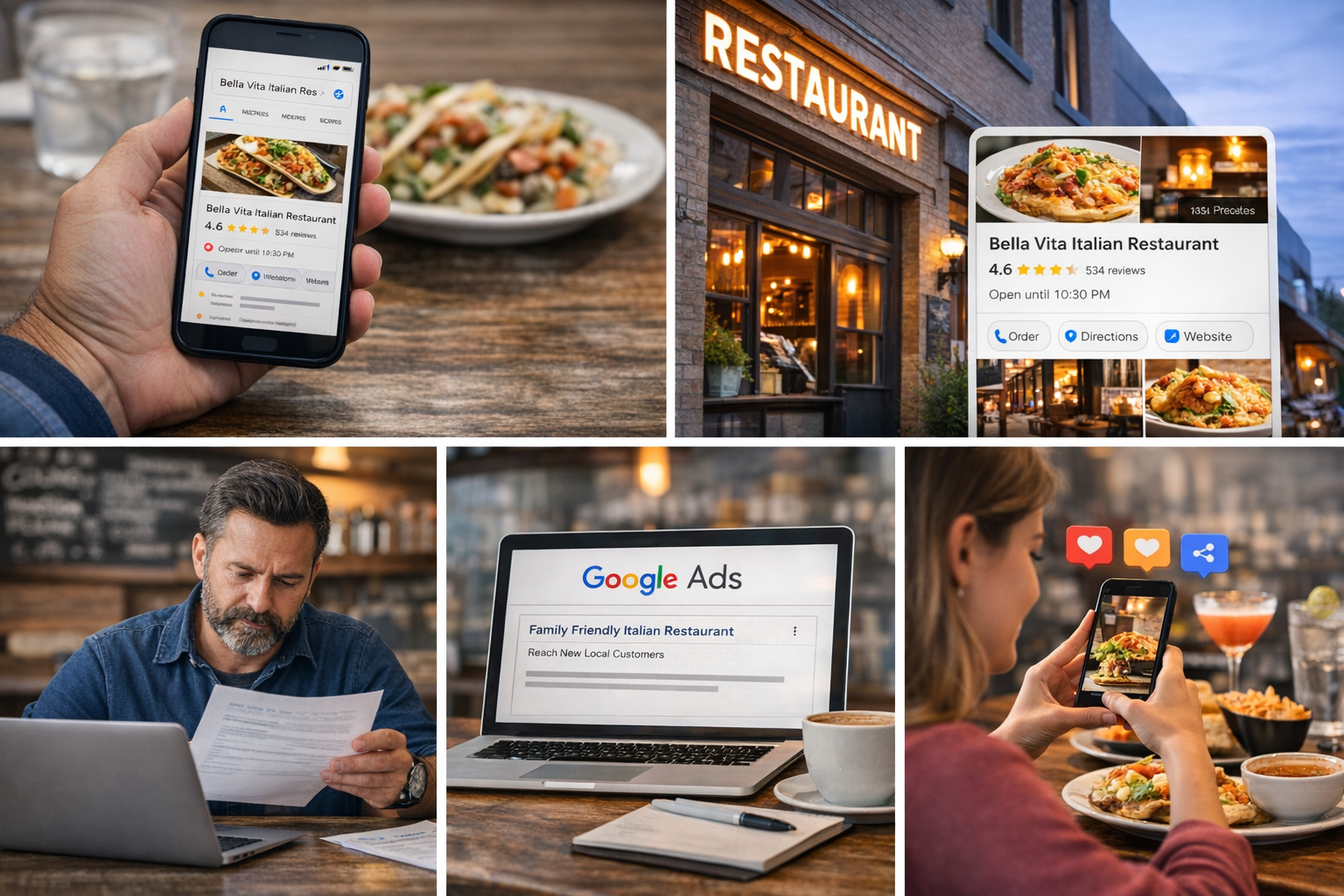

Digital marketing for restaurants refers to the set of online strategies that help a restaurant become visible when people are deciding where to eat. It includes elements such as local search visibility, Google Business listings, social media discovery, paid advertising, and the restaurant’s own website.
For restaurant owners and managers, this topic matters because many dining decisions are now made before guests leave home. A potential customer may search Google Maps, browse social media, or check reviews before choosing where to go. If a restaurant is difficult to find or does not present clear information online, it can lose opportunities even when the food and service are strong.
Understanding how digital marketing works helps restaurant operators make informed decisions about where to invest time and resources. Rather than relying on a single platform or trend, the goal is to create consistent visibility across the channels diners actually use when deciding where to eat.
Digital marketing for restaurants is not one tactic. It is a system that connects several forms of online visibility.
In practice, restaurant marketing often includes:
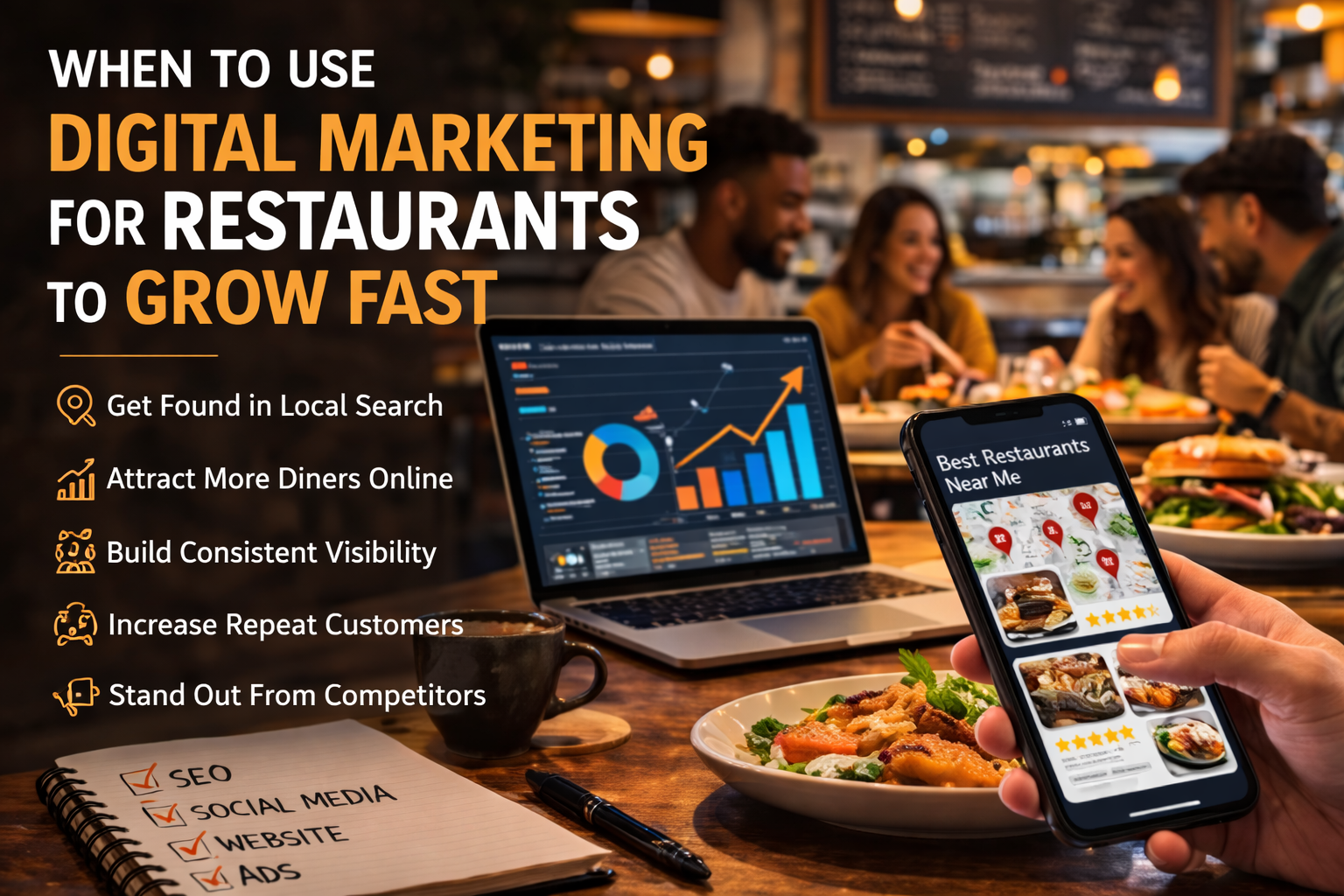
Together, these elements help a restaurant appear when diners search for nearby options, compare reviews, or explore new places to try.
The importance of this visibility becomes clearer when considering how people now choose restaurants.
In many U.S. cities such as New York, Los Angeles, Chicago, Houston, and Miami, diners rarely arrive at a restaurant without first seeing it online. Even tourists frequently rely on map results, reviews, and social content to narrow their choices.
Restaurants that appear consistently in these digital touchpoints tend to attract more first-time guests.
One misconception in the industry is that strong food and word of mouth will naturally translate into online visibility.
In reality, digital platforms operate according to specific signals. Search engines and social platforms display businesses based on relevance, completeness of information, activity, and user engagement.
A restaurant might struggle to appear in search results if:
These issues are common, especially for independent restaurants that focus primarily on operations rather than marketing.
A restaurant could be highly rated by existing customers but still remain difficult to discover for new diners.

Local SEO helps search engines understand where a restaurant is located and what type of food it offers.
This involves consistent information about the restaurant’s name, address, and phone number across platforms. It also includes location-specific keywords and structured website content that clarifies menu offerings and geographic relevance.
When implemented effectively, local SEO increases the likelihood that a restaurant appears in map results and local search listings.
However, results are rarely immediate. Search visibility develops over time as search engines gain confidence in the business’s information and reputation.
The Google Business Profile is often the first piece of information a diner encounters.
It displays key details such as:
Because Google frequently presents map listings before website results, the business profile can strongly influence whether someone decides to visit.
Restaurants that maintain accurate information and respond to reviews tend to provide clearer signals to both customers and search platforms.
Even in an era of social media discovery, a restaurant’s website remains an important reference point.
Guests often visit a website to confirm details such as:
Effective restaurant website design focuses on clarity rather than complexity. Pages should load quickly, display well on mobile devices, and present essential information without requiring extensive navigation.
A common oversight is neglecting mobile usability. In many urban markets, a large share of restaurant website visits occur from mobile searches.
Social platforms play a different role than search engines.
While search captures people who are already looking for a place to eat, social media often introduces restaurants to potential diners who were not actively searching.
Photos, short videos, and behind-the-scenes content can give viewers a sense of the dining experience.
However, social media alone rarely provides a complete marketing strategy. Visibility on platforms such as Instagram or TikTok does not necessarily translate into consistent customer traffic if the restaurant is difficult to find through search.
Paid search advertising can complement organic visibility efforts.
Google Ads allow restaurants to appear at the top of search results for specific queries such as “Italian restaurant near me” or “best tacos in downtown Chicago.”
For some restaurants, ads help capture demand during peak tourist seasons or promotional periods. However, advertising requires careful budget management and realistic expectations.
Paid campaigns can increase visibility quickly, but they do not replace the need for strong foundational elements such as website quality and local search optimization.
One issue often overlooked in online advice is the belief that a single channel can drive consistent restaurant growth.
Some restaurant owners focus almost entirely on social media. Others rely heavily on delivery platforms or paid ads.
Each channel has value, but dependence on one source can create vulnerability.
For example, a restaurant that relies mainly on social media might experience declining reach as algorithms change. A restaurant dependent on delivery apps may face rising platform fees that reduce profitability.
Balanced restaurant digital marketing services usually combine several channels so that visibility is not dependent on one platform.
In practice, restaurant marketing decisions are rarely purely strategic. They are influenced by staffing, time, and operational pressures.
A small restaurant might have limited capacity to manage social media, respond to reviews, and update website content simultaneously.
In these situations, some restaurants explore Marketing Packages for Restaurants offered by marketing agencies or consultants. These packages typically bundle services such as local SEO, social content planning, and website management.
However, restaurant owners should evaluate these services carefully.
Important questions include:
Marketing packages vary widely in scope and cost, so understanding the details is essential.
Many articles about restaurant marketing focus on tactics without discussing practical limitations.
In reality, marketing outcomes depend on several factors:
For example, a neighborhood café in a suburban area may rely heavily on repeat customers and local search visibility. A destination restaurant in a major city might benefit more from social discovery and travel guides.
No single approach applies to every restaurant. Context matters.
Understanding this helps restaurant owners evaluate advice more critically rather than assuming that a particular tactic will work universally.
Consider a mid-sized restaurant in Houston that has strong reviews and loyal regular customers.
During the first few years, word of mouth provides steady traffic. However, the restaurant begins noticing slower weekday evenings.
After reviewing online presence, the owner discovers several issues:
None of these problems relate to the quality of the food. Instead, they affect how easily new diners can discover the restaurant online.
By addressing these visibility gaps, the restaurant improves its chances of appearing in searches when new customers are exploring nearby options.
This example illustrates why digital marketing is often less about promotion and more about discoverability.
Restaurant owners evaluating marketing options may find it useful to review their presence across several categories.
Evaluating these factors can help identify areas where digital marketing efforts may need improvement.
Digital marketing for restaurants involves more than advertising or social media activity. It is a system that helps diners discover a restaurant during the decision-making process.
Key components such as local search visibility, Google Business listings, restaurant websites, and social media presence each contribute to how easily potential customers find and evaluate a restaurant.
For restaurant owners and managers, understanding how these elements interact provides a clearer perspective on marketing decisions. Rather than relying on isolated tactics, a balanced approach that reflects the restaurant’s location, audience, and operational capacity often leads to more sustainable visibility.
Thoughtful evaluation and realistic expectations remain essential when exploring restaurant digital marketing services or marketing packages.
Digital marketing for restaurants typically includes local search optimization, Google Business Profile management, website development, social media marketing, and paid advertising campaigns. These activities aim to improve how easily diners can discover the restaurant online.
Local SEO helps search engines connect a restaurant with nearby diners searching for specific cuisines or dining experiences. When a restaurant appears in local map results, it becomes more visible to people actively looking for places to eat.
Social media can introduce potential customers to a restaurant, but a website often provides more detailed information such as menus, reservations, and location details. Many diners check a restaurant’s website before deciding whether to visit.
Marketing packages are not always required, but they can help restaurants that lack time or internal expertise to manage multiple digital marketing activities. Owners should evaluate the scope of services carefully before committing.
Timeframes vary depending on the strategy used. Paid advertising may increase visibility quickly, while local SEO improvements typically develop over several months as search engines recognize updated information.
Restaurant digital marketing services usually include professional support for tasks such as search optimization, website design, social media management, and advertising campaign management.
If you are exploring restaurant digital marketing services and want a clearer understanding of available options, a strategy discussion can help clarify priorities and potential approaches.
These conversations are designed to review current visibility, discuss practical considerations, and support informed decision-making without pressure.